

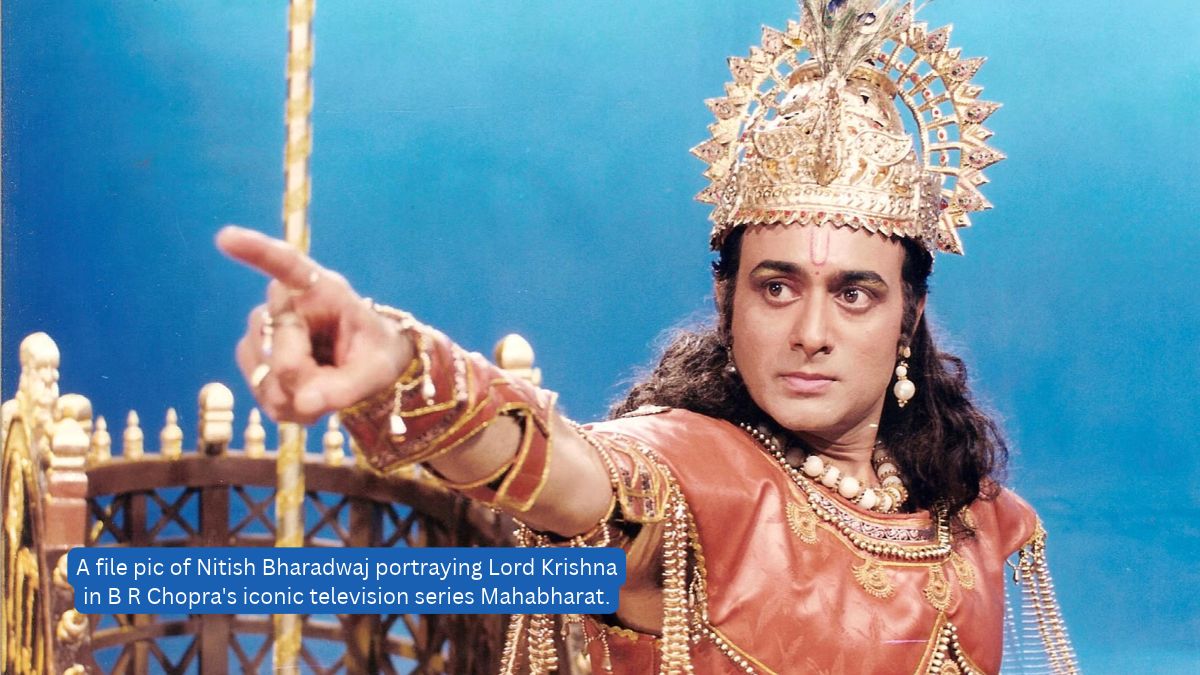
Actor Nitish Bharadwaj, best known for portraying Lord Krishna in B R Chopra’s iconic television series ‘Mahabharat’, has strongly criticised Nitesh Tiwari’s ‘Ramayana: Part 1’, alleging that the film undermines Hindu gods and distorts the fundamental moral and spiritual framework of the epic.
In a strongly worded social media statement, Bharadwaj withdrew his earlier appreciation of the film, saying he was deeply upset and disappointed after watching it. He argued that the cinematic interpretation had moved away from the philosophical depth and civilisational significance of the original ‘Ramayana’.
One of his principal objections concerns the portrayal of Ravana. Bharadwaj questioned the film’s apparent presentation of the Lankan king as an exceptionally liberal, socially just and fair figure.
According to the actor, such a characterisation alters the moral framework of the epic and diminishes the very purpose of Lord Vishnu taking human form as Lord Rama.
Bharadwaj argued that Ravana’s villainy cannot be softened or redefined without affecting the central philosophical message of the story. He also questioned the depiction of Ravana in the context of his treatment of women, referring to episodes involving Rambha and Vedavati in traditional accounts.
In one of his social media slides, titled ‘Ravan the lustful molester’, he argued that Ravana’s conduct towards women was an essential part of understanding his character. He maintained that the film’s interpretation risked presenting the antagonist as a liberator rather than acknowledging the darker aspects of his actions.
His second major objection concerned the concept of the Ram avatar.
Bharadwaj questioned why Mahavishnu would take the form of Lord Rama if Ravana were presented as a socially just and exceptionally liberal ruler. He argued that the portrayal weakened the moral contrast between the protagonist and antagonist that forms an essential part of the epic.
The actor also made a strong observation about the film’s treatment of mythology and visual spectacle.
“A spectacle of VFX can never substitute for the core values, philosophical depth and spiritual essence of this Mahakavya,” he wrote, expressing his belief that technological grandeur cannot compensate for what he considers fundamental narrative distortions.
Bharadwaj went further, saying that the film did not deserve to represent Indian cinema internationally because, in his opinion, its narrative misrepresented India’s history, heritage and core spiritual values.
His comments are particularly significant because he had initially praised the film following the release of its promotional material. He had even predicted that the ambitious production could win an Oscar. His subsequent withdrawal of that appreciation indicates the extent of his disappointment after watching the finished film.
Directed by Nitesh Tiwari and produced by Namit Malhotra, ‘Ramayana: Part 1’ stars Ranbir Kapoor as Lord Rama, Sai Pallavi as Sita and Yash as Ravana. Ravi Dubey plays Lakshman, while Sunny Deol appears as Hanuman.
The film has generated considerable discussion not only because of its enormous production scale and visual effects but also because of the creative liberties taken with characters and episodes familiar to generations of Indians.
Bharadwaj’s criticism adds another dimension to the debate. While some viewers have focused on the performances, music and technical execution, his objections concern the philosophical interpretation of the epic itself.
The controversy also raises a larger question about the creative freedom involved in adapting religious and mythological narratives for contemporary cinema. Filmmakers may interpret familiar characters differently, but such choices can invite intense scrutiny when the source material carries deep religious and cultural significance for millions of people.
For Bharadwaj, the issue is not simply whether the film succeeds as a cinematic spectacle. It is whether the spectacle remains faithful to what he considers the essential spirit of the ‘Ramayana’.
